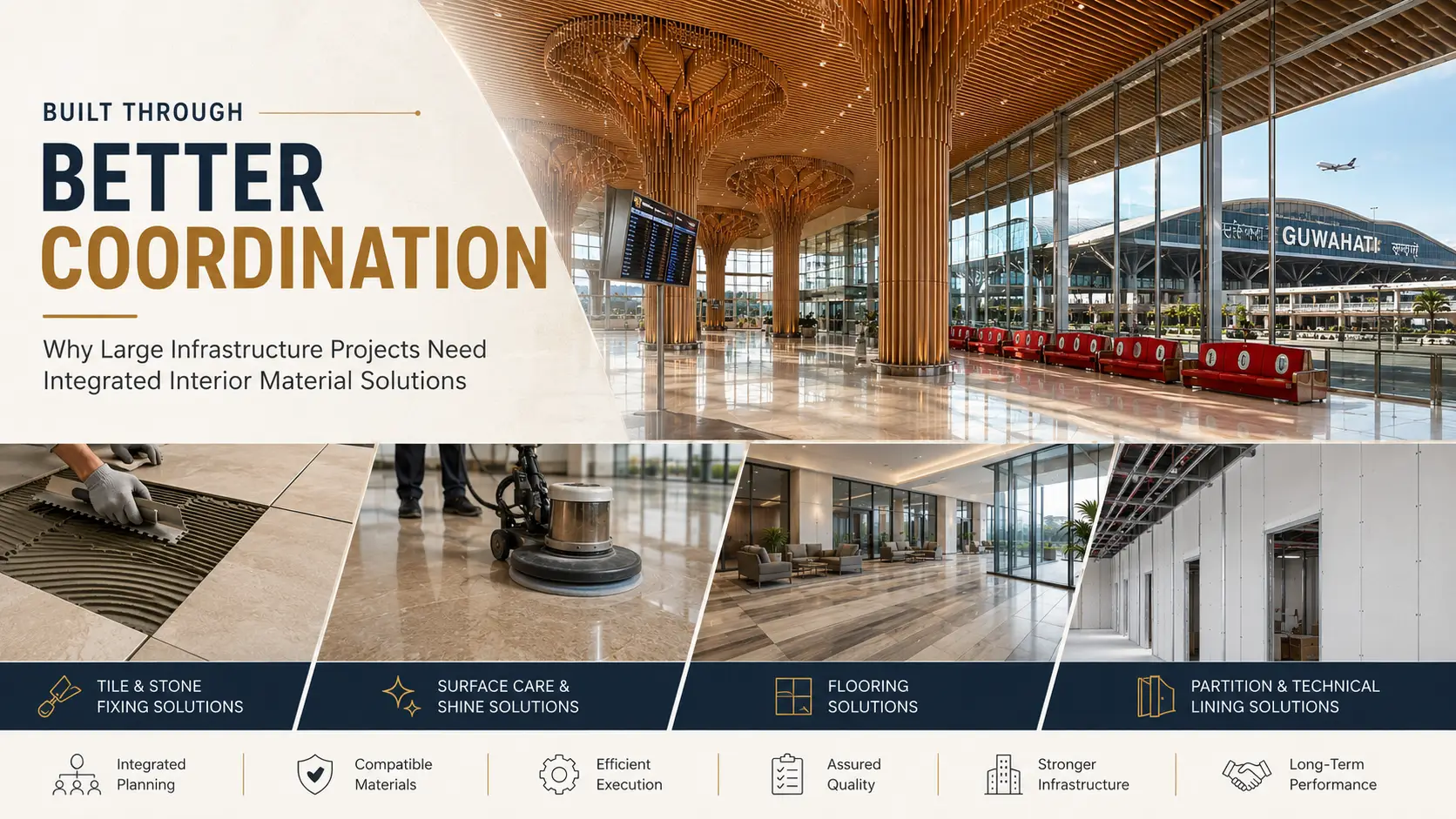
Why Large Infrastructure Projects Need Integrated Interior Material Solutions
Large commercial and infrastructure projects are rarely defined by a single product, material, or system.
Airports, corporate campuses, hospitality developments, institutional buildings, and other high-traffic environments depend on multiple specialised solutions working together. Flooring, adhesives, surface-treatment products, partitions, technical linings, ceilings, access systems, and finishing materials must all be selected and coordinated according to the same project requirements.
The final appearance may be what visitors notice first, but the long-term performance of the space depends on decisions made much earlier—from material compatibility and installation planning to supplier coordination and execution support.
This is why large projects benefit from an integrated approach to interior materials rather than treating every product category as a separate and unrelated purchase.
Large Projects Are Built Through Coordinated Systems
A large infrastructure project may involve hundreds of products and multiple contractors working across different areas of the building.
Each material has its own technical requirements, but it must also work effectively with the surrounding systems.
For example:
- Tile and stone finishes depend on the correct adhesive and substrate preparation.
- Polished surfaces require suitable cleaning, protection, and maintenance products.
- Flooring must respond to traffic, load, moisture, access, and maintenance requirements.
- Partitions and technical linings must coordinate with mechanical, electrical, fire, and acoustic requirements.
- Ceiling systems must accommodate lighting, air-conditioning, fire services, and access panels.
When these decisions are made independently, projects may face compatibility issues, delays, repeated approvals, inconsistent quality, and unclear responsibility.
An integrated material strategy helps connect the visible finishes with the technical requirements behind them.
Why Material Coordination Matters
1. Compatibility Between Products
Materials that appear suitable individually may not always perform correctly when used together.
Adhesives must be compatible with the substrate and the selected tile or stone. Surface-treatment products must suit the material being cleaned or polished. Partition boards, framing, insulation, sealants, and finishing products must be selected as part of one coordinated assembly.
Early product coordination helps reduce the risk of:
- Poor adhesion
- Surface staining
- Cracking or debonding
- Uneven finishes
- Premature material failure
- Incompatible installation methods
- Unplanned maintenance requirements
2. More Efficient Procurement
Large projects require clear product specifications, approved samples, technical documentation, delivery schedules, and quantity planning.
Working with a supplier or solution partner across multiple categories can simplify this process by reducing the number of separate coordination points.
A more organised procurement approach can support:
- Consolidated material planning
- Faster product comparisons
- Clearer approval tracking
- Better coordination of delivery timelines
- Reduced risk of missing supporting products
- More consistent communication between project teams
3. Better Execution Planning
Material selection affects how and when work is carried out on site.
Tile adhesive requires suitable substrate preparation and curing conditions. Surface polishing and protection may need to happen after installation but before handover. Partition systems must be coordinated with services before boards are closed. Flooring may need to be protected while other trades continue working.
When materials are planned as part of the overall construction sequence, project teams can reduce rework and avoid clashes between trades.
4. Consistent Quality Across the Project
Large projects often include many different areas, each with its own performance and design requirements.
Public zones, service areas, technical rooms, offices, lounges, washrooms, circulation spaces, and back-of-house environments may all require different solutions.
Integrated material planning helps ensure that each area receives the appropriate product while maintaining a consistent standard of quality across the project.
5. Clearer Accountability
When too many disconnected suppliers are involved, identifying the cause of a material or application issue can become difficult.
A coordinated solution partner can help project teams review the relationship between the material, substrate, application method, and surrounding systems.
This does not replace the responsibility of designers, consultants, contractors, or manufacturers. However, it creates a clearer channel for product selection, technical communication, and supply coordination.
Tile and Stone Installation Begins with the Right Adhesive
Tiles and natural stones are among the most visible finishes in commercial and infrastructure projects.
Their long-term performance depends on much more than the appearance of the tile or stone itself. The substrate, adhesive, installation method, joint planning, environmental conditions, and expected movement must all be considered.
Important selection factors include:
- Type and size of tile or stone
- Interior or exterior application
- Wall or floor installation
- Substrate type
- Moisture exposure
- Temperature variation
- Expected foot traffic
- Movement and vibration
- Required setting and curing time
Large-format tiles, vitrified tiles, natural stone, metal surfaces, plywood, cement boards, and other specialised substrates may require different adhesive characteristics.
Using a general-purpose fixing method for every application can increase the risk of hollow areas, cracking, movement, or loss of adhesion.
Professional tile and stone adhesive solutions from brands such as Roff help project teams select products according to the actual application rather than relying on one solution for every surface.
Surface Quality Continues After Installation
Tile and stone installation is only one stage of the finishing process.
Natural stone, marble, granite, and other premium surfaces may require cleaning, polishing, protection, repair, or periodic maintenance to retain their intended appearance.
The wrong cleaning chemical or polishing method can affect the surface colour, gloss, texture, or protective treatment.
Professional surface-care planning may include:
- Cleaning after installation
- Removal of construction residue
- Polishing and gloss enhancement
- Stain protection
- Surface sealing
- Repair of minor imperfections
- Ongoing maintenance recommendations
Specialised solutions from brands such as Tenax can support tile and stone finishing, polishing, protection, and surface maintenance requirements.
Product selection should always be based on the exact stone type, existing finish, application method, and desired result.
Flooring Must Balance Design and Performance
Flooring in large public and commercial projects must perform under continuous use while contributing to the visual identity of the building.
The most appropriate solution depends on the area in which it will be installed.
Project teams may need to evaluate:
- Expected foot traffic
- Point and distributed loads
- Slip resistance
- Cleaning and maintenance
- Moisture and chemical exposure
- Acoustic requirements
- Fire-performance requirements
- Access to services
- Replacement and repair methods
- Compatibility with surrounding finishes
In some areas, the priority may be durability and easy cleaning. In others, the project may require access beneath the floor, modular replacement, or coordination with technical services.
Flooring solutions such as Unitile Forza can form part of a broader flooring strategy for commercial and infrastructure environments.
The selected system should respond to the application, load, maintenance expectations, and project design rather than being chosen only for visual appearance.
Partitions and Technical Linings Support Building Performance
Partitions are often described as elements that divide space, but their role in a large project is much broader.
Partition and lining systems may contribute to:
- Space planning
- Fire separation
- Acoustic control
- Thermal performance
- Service concealment
- Moisture resistance
- Surface finishing
- Maintenance access
Technical areas such as air-handling-unit zones, mechanical rooms, shafts, service corridors, and controlled environments may require specially planned lining and partition assemblies.
These systems must coordinate with framing, boards, insulation, sealants, service penetrations, access panels, and finishing products.
Solutions from USG Knauf can support partition, lining, ceiling, acoustic, and technical interior requirements across different project environments.
The exact assembly should be selected according to the required fire, acoustic, moisture, structural, and service-performance criteria.
Different Areas Require Different Solutions
A large infrastructure building contains many environments within one project.
An airport, for example, may include:
- Arrival and departure halls
- Passenger circulation areas
- Retail and food zones
- Lounges
- Washrooms
- Office areas
- Security zones
- Baggage-handling areas
- Mechanical and electrical rooms
- Service corridors
- External landscaped spaces
Each area has different requirements for durability, cleaning, safety, acoustics, fire performance, maintenance, and appearance.
Integrated product planning allows the project team to select different solutions while maintaining one coordinated technical and commercial approach.
The Value of Working with an Experienced Solution Partner
Product availability alone is not enough for a complex project.
Architects, consultants, contractors, developers, and procurement teams often require support with understanding applications, comparing systems, coordinating brands, reviewing availability, and planning deliveries.
An experienced solution partner can assist with:
- Understanding the project application
- Identifying suitable product categories
- Coordinating across multiple brands
- Supporting technical discussions
- Managing product and sample requirements
- Planning material availability
- Coordinating supply schedules
- Supporting contractors during execution
The objective is not simply to supply multiple products. It is to help ensure that each selected solution fits within the wider project strategy.
TBT Group’s Multi-Brand, Multi-Solution Approach
Tirupathi Balaji Traders – TBT Group works across multiple workspace, interior, flooring, adhesive, surface-care, ceiling, partition, access, and infrastructure solution categories.
This wider product portfolio allows TBT Group to support different stages of a commercial or infrastructure project through one coordinated channel.
Depending on the project, support may include:
- Tile and stone fixing solutions
- Stone-care and polishing products
- Raised and specialised flooring systems
- Partitions and technical linings
- Ceiling and acoustic solutions
- Door and access systems
- Workspace furniture and ergonomic seating
- Product sourcing and execution coordination
Working across multiple categories also helps TBT Group understand the connections between products instead of treating every material requirement in isolation.
Project Association: New Guwahati Airport
TBT Group was associated with selected material requirements for the New Guwahati Airport project through multiple specialised brands and product categories.
The material associations included:
- Roff for tile and stone adhesive solutions
- Tenax for tile and stone shine and surface-care requirements
- Unitile Forza for flooring solutions
- USG Knauf for AHU lining and partition requirements
This association demonstrates how one large infrastructure project can require coordinated support across several material categories.
It also reflects the value of bringing together trusted brands, specialised products, and project-focused coordination through one experienced solution partner.
Better Coordination Creates Better Project Outcomes
Large infrastructure and commercial projects require more than premium-looking materials.
They require products that are technically appropriate, compatible with surrounding systems, available according to the construction schedule, and installed using the correct methods.
An integrated material strategy can help project teams reduce uncertainty, improve coordination, maintain quality, and prepare the building for long-term use.
From the adhesive beneath a tile to the partition surrounding a technical service area, every product contributes to the overall performance of the project.
Better outcomes begin when these materials are planned as connected parts of one complete system.
Planning a Commercial or Infrastructure Project?
Connect with Tirupathi Balaji Traders – TBT Group for coordinated workspace, flooring, adhesive, surface-care, ceiling, partition, access, and interior solution requirements.