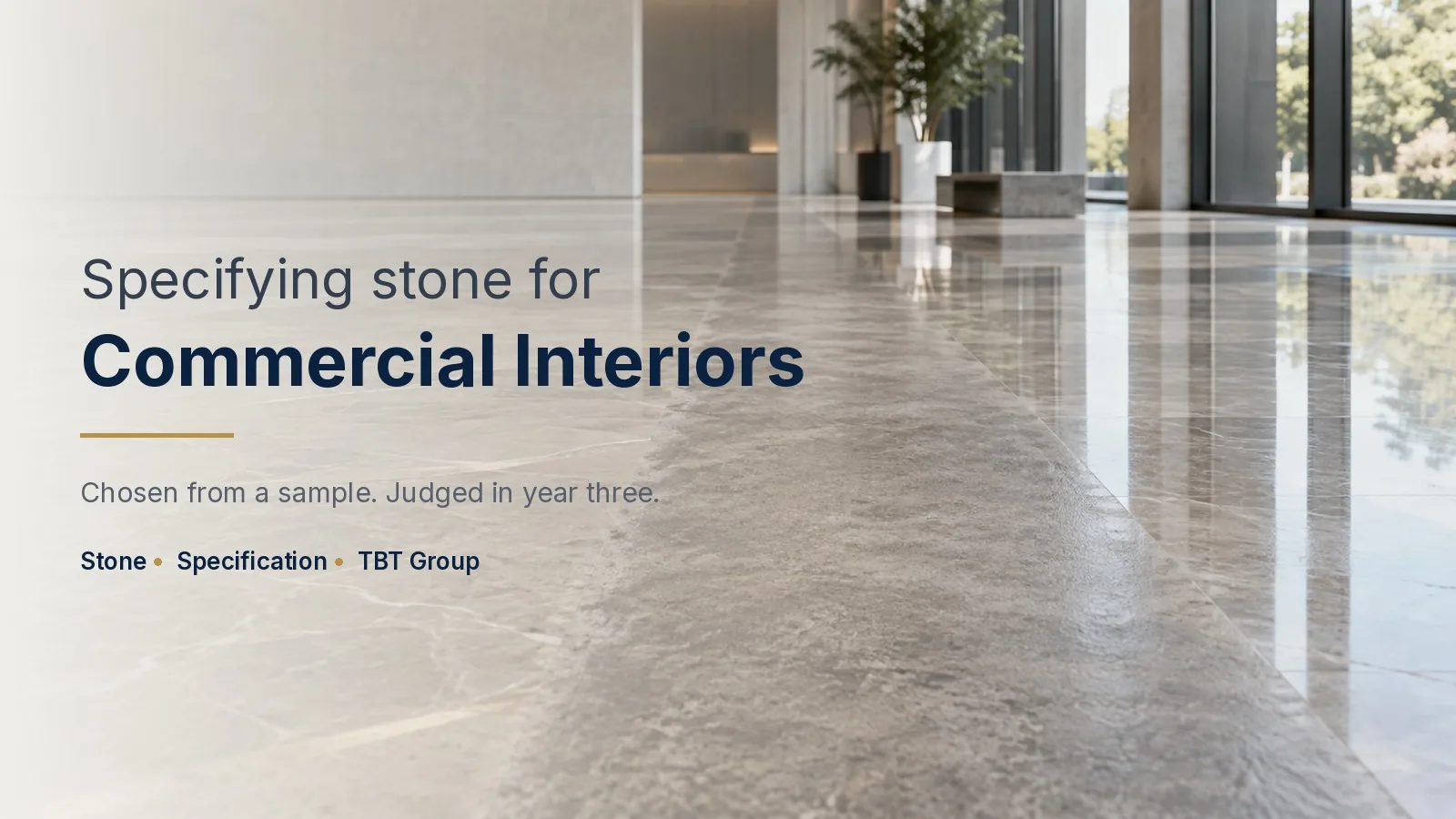
Stone is almost always specified the same way. A box of samples arrives, someone holds them up against the joinery board in good light, and one gets picked because it looks right.
Three years later the same floor is judged by a completely different standard. Not how it looked in the box, but how the traffic lane from the lift to the reception desk has gone dull while the edges stayed bright. Whether the mark where a planter sat is permanent. Whether the grout that started pale is now a darker line around every slab.
None of that is visible in a sample. All of it is decided at specification.
This guide covers the decisions between those two moments - what to choose, how to finish it, how it is fixed and sealed, and what maintenance the choice quietly commits the building to. It is written for the people who specify stone and the people who end up owning it, who are rarely the same person.
If you are looking at stone as one part of a wider material package, our post on integrated interior material solutions covers how these decisions interact across a large project. This one stays with stone.
The decision you are actually making
Choosing stone is not choosing a look. It is choosing a maintenance commitment, and then choosing a look within it.
Two materials can be indistinguishable on the sample board and behave nothing alike in a working building. One shrugs off a spilled coffee. The other takes a permanent mark from the same cup. One can be brought back to new with a restorative polish in a weekend. The other cannot be brought back at all, because the finish was never mechanical in the first place.
So the first question is not which stone. It is what is this floor going to be asked to survive, and who is going to look after it. Answer that honestly - including the part about whether the building actually has a cleaning contract worth the name - and the material shortlist narrows itself.
Start with the traffic, not the stone
Different areas of the same building make genuinely different demands, and specifying one material throughout is how buildings end up with a lobby that looks tired while the boardroom looks new.
Entrance and lobby. The hardest condition in the building. Grit tracked in from outside is abrasive, and it is the grit underfoot - not the footfall itself - that does the abrading. This is where the hardest, most abrasion-resistant material belongs, and where the entrance matting system matters as much as the stone. A properly sized matting run, long enough for several footfalls, removes a large share of what would otherwise be sandpapering the floor for the next decade. Undersize the matting and no stone choice will save the lobby.
Circulation and lift lobbies. Concentrated traffic on a narrow path. The failure mode here is not damage, it is uneven wear - a visible lane where everybody walks. Materials and finishes that hide this are worth more than materials that resist it, because the lane will appear eventually.
Reception desks, counters and vertical surfaces. Lower abrasion, higher stain and chemical risk. Hand contact, drinks, cleaning products, hand sanitiser. Vertical stone rarely wears; it stains.
Washrooms and wet areas. Water, cleaning chemicals and slip risk together. Slip performance must be specified and tested in the wet condition to the standard applying to the project - pendulum, ramp or DCOF, depending on the code being worked to - and never assumed from how a dry sample feels underfoot. Aggressive washroom cleaners are also a leading cause of etching on calcium-based stone.
Boardrooms and executive floors. Low traffic, high scrutiny - the one place where a more delicate material and a more demanding finish can be justified, because the conditions are gentle and the expectation is high.
Marble, granite and the engineered options
A short, honest summary of the families, without pretending any of them is a universal answer.
Marble and other calcium-based stones - including travertine, limestone and onyx - are the ones people mean when they say stone should look like stone. They are also chemically reactive. Anything acidic, from lemon juice to a descaling cleaner, dissolves a microscopic layer of the surface and leaves a dull mark. That is etching, not staining, and it is a physical change rather than something sitting on the surface, so no amount of cleaning removes it. It is repaired mechanically: light etching on a honed surface often lifts with a polishing powder or pad, heavier etching needs re-polishing.
Granite and other silicate stones are harder, far more abrasion-resistant and much more chemically stable. The abrasion difference is the one that matters underfoot, and it is measurable - the ASTM minimum for granite is more than double that for marble and limestone. Granite holds a polish under traffic that would dull marble, and shrugs off most of what gets spilled in a commercial building.
Two things it is not. It is not categorically less porous: permitted absorption for granite is actually higher than for marble under the ASTM specifications, so plenty of commercial granites still need sealing. And it is not universally acid-proof - some commercial granites carry carbonate minerals, and much of what is sold as black granite is geologically something else altogether. Those will etch. Confirm with the supplier rather than trusting the family name.
The real trade-off is aesthetic range: granite reads as granite, and the soft, veined, quiet look that drives most specifications is not in its vocabulary.
Engineered stone and porcelain solve the maintenance problem directly. Modern large-format porcelain is dense, effectively non-porous and can carry a convincing stone pattern. Glazed porcelain needs no sealing - though polished and unglazed porcelain often does, because polishing opens pores that firing had closed, and the grout needs sealing either way. What it cannot do is age like stone or offer a genuinely unique slab. If the specification is driven by the character of a real material, porcelain will disappoint over time. If it is driven by a look that has to survive a canteen, porcelain is frequently the right answer, and is worth putting on the table honestly rather than defending natural stone into a condition it will lose.
Porosity varies enormously within each family, not just between them. Two marbles from different quarries can absorb water at completely different rates. Get the absorption figure for the specific material being supplied, not for the category.
Finish changes everything
The same block of stone, cut and finished four ways, produces four materials with different maintenance lives.
Polished is the most reflective and the most revealing. A polished surface is a mirror, so every scratch, etch mark and worn lane shows as a break in the reflection. It is also the most durable in one narrow sense - the surface is closed and tight, so it takes up less. In a low-traffic, well-maintained space, polished stone looks exceptional. In a busy lobby it is a commitment to re-polishing.
Honed is flat and matte. It hides scratching and light etching far better, because there is no reflection to interrupt. It is more open than polished stone and so more absorbent, which raises the importance of sealing. For most commercial circulation, honed is the pragmatic choice.
Leathered and brushed finishes add a light texture that hides both wear and marking well, and improves grip. They are harder to clean for exactly the same reason - texture holds soil.
Flamed and bush-hammered are heavy textures, mainly external or transitional, with the best wet grip and the worst cleanability.
There is a pattern here worth stating plainly: the better a finish hides wear, the harder it is to clean; the easier it is to clean, the more it shows. There is no finish that does both, and choosing one means deciding which problem the building would rather have.
Most stone failures are fixing failures
When a stone floor goes wrong early in its life, the stone is commonly not at fault. The failure is underneath it.
The adhesive has to suit both the stone and the substrate, and stone is not tile. Some light-coloured and translucent materials show the adhesive through the slab, which is why white adhesives exist for them. Separately - and this is a different problem with a different answer - some stones are moisture-sensitive: held against water they darken permanently, and can curl, warp or debond outright. That is what rapid-set adhesives are for, because they limit how long mix water stays in contact with the stone. Confusing the two is how a specification ends up calling for the wrong product. Large-format slabs need a solid bed - effectively full coverage for natural stone, and no less than 95 per cent in wet and heavily trafficked areas. Voids under a slab become hollow spots, then cracks under point loads.
Grout choice is a maintenance decision, not a cosmetic one. Cementitious grout is porous and will darken with traffic and cleaning unless sealed and maintained. Epoxy grout costs more, takes longer to install and needs a contractor who has done it before, but it does not absorb, which in a canteen or a washroom repays itself. The Roff range includes both, along with the waterproofing that sits beneath wet areas. Whatever the source, confirm the specific product is warranted for natural stone rather than tile alone - the distinction this section is built on applies to the adhesive aisle too. These are decisions worth making at specification rather than discovering on site.
Movement joints are the other silent failure. Stone moves with temperature, and the structure moves on its own account - screed shrinkage as it dries, slab deflection under load, moisture movement. If nothing in the floor is allowed to absorb that, the stone will relieve it by cracking or debonding. Joints belong at structural movement lines, at perimeters, at thresholds, and at the bay spacing the tiling standard requires - broadly 8 to 10 metres each way for a normal internal floor, dropping to around 5 with underfloor heating or heavy solar gain. A deformable adhesive supplements those joints; it never replaces them. They are easy to omit on a drawing and expensive to retrofit into a finished floor.
Sealing is a system, not a product
Sealing is the most misunderstood part of a stone specification, largely because the word covers two completely different things.
Impregnating or penetrating sealers soak into the stone and line its pores from within, leaving the surface looking unchanged. They do not sit on top, so they cannot peel, and they do not alter the finish. This is what almost every commercial interior wants.
Topical sealers form a film across the surface. They change the appearance, can add slip risk when wet, and wear through in traffic lanes - which means patchy re-coating rather than uniform maintenance. They have their uses, but a busy commercial floor is rarely one of them.
Three things worth being clear about with any client:
A sealer buys time, it does not confer immunity. It slows absorption so a spill can be wiped up before it penetrates. Leave the same spill overnight and it will still stain. Staff who believe the floor is "sealed, so it's fine" cause more damage than staff who know they have minutes, not hours.
An impregnating sealer does not prevent etching. Etching is a chemical attack on the stone itself, and the sealer sits below the surface being attacked, lining the pores rather than covering them. On calcium-based stone, acid will still mark a sealed floor. Only a film-forming topical coating interposes anything between the acid and the stone, and it brings back every problem listed above - appearance, wet slip, and patchy re-coating.
And sealing is not a one-off. Re-application intervals vary widely with product, material and traffic - from about a year to several - and the honest answer at specification stage is that the interval comes from the sealer manufacturer's data for that stone in that condition, and belongs in the building's maintenance schedule from handover. A water-drop test tells you where you are: place a few drops, cover them with an upturned glass so they cannot evaporate, and look at 15 and 30 minutes. If the water still beads, the sealer is working; if the stone has darkened, it is due. One limitation worth knowing - beading proves water repellency only. Most impregnating sealers are not equally oil-repellent, so where oil is the real risk, in a canteen or a lobby, run an oil spot test alongside it.
The regime that decides year three
Everything above is a one-time decision. This part repeats forever, and it is what actually determines how the floor looks when someone photographs it for a refurbishment tender.
Daily. Dry removal of grit first - dust mop or vacuum - before anything wet. Wet-mopping an unswept stone floor grinds the grit into the surface. Damp mop with a pH-neutral stone cleaner, and change the water before it turns grey.
Never. Acidic cleaners, vinegar, descalers and bathroom limescale removers on calcium-based stone. Generic supermarket floor cleaners of unknown pH. Abrasive pads on a polished surface. This list needs to be handed to the cleaning contractor in writing, because it is not general knowledge, and a single well-meaning contractor with the wrong product can etch an entire lobby in one night.
Periodically. Deep clean to lift soil that daily cleaning leaves behind, inspect the seal, and re-seal when the water test says so. Where a traffic lane has begun to dull, restorative polishing works the surface back mechanically. Provided the finish was mechanical to begin with - not a resin, wax or topical coating imitating one - this is the quiet advantage of natural stone over almost every other hard finish: it can be renewed in place, again and again, without replacement. A dull lobby becomes a weekend of work rather than a capital project. The limit is slab thickness, and heavily filled or resin-backed material, which will not take repeated honing.
Immediately. Spills wiped rather than left. Planters on feet rather than flat on the stone, with a drip tray, because the mark under a planter is one of the most common permanent stains in a commercial building, and it comes from standing water, fertiliser salts and rust off a metal base - not from the plant.
What belongs in the specification
Most stone problems trace back to something that was never written down. At minimum:
- The specific material, quarry or supplier reference, and its measured water absorption - not just the trade name
- Finish, by area, with the reasoning recorded
- Slip resistance requirement for wet areas, tested to the applicable standard
- Adhesive and grout type, stating separately whether the stone needs a white adhesive for show-through and whether it is moisture-sensitive enough to need a rapid-set
- Movement joint locations and bay spacing, to the tiling standard rather than to the adhesive data sheet
- Sealer type - impregnating or topical - with its manufacturer's re-application interval
- A cleaning regime handed over at practical completion: approved products, prohibited products, daily and periodic tasks
- Replacement slabs from the same batch, stored on site, because a slab matched three years later will not match
That last one costs almost nothing at the time of order and is impossible to fix afterwards.
The short version
| Decision | The question behind it | Common mistake |
|---|---|---|
| Material | What does this area have to survive? | One material specified throughout the building |
| Finish | Should it hide wear or clean easily? | Polished stone in a high-traffic lobby |
| Fixing | Does the adhesive suit this stone and substrate? | Treating stone as tile |
| Movement joints | Where is movement allowed to go? | Omitted, then relieved by cracking |
| Sealing | Impregnating or topical, and re-applied when? | Assuming sealed means stainproof |
| Cleaning | Who is doing it, with what? | Acidic cleaner on marble |
| Spares | Will a replacement match in year three? | No batch-matched spares held |
Stone rewards specification and punishes assumption. Everything that makes it look bad in year three was decided, or left undecided, before anyone walked on it.
Planning a project with stone in it?
Tirupathi Balaji Traders - TBT Group supplies, installs and maintains stone for commercial interiors, alongside flooring, ceiling systems, acoustic solutions, ergonomic seating, access hardware and adhesives. We can advise on material and finish selection at specification stage, carry out the installation, and hold the aftercare regime after handover. Talk to us about your project.
Planning a project with stone in it?
Tirupathi Balaji Traders - TBT Group supplies, installs and maintains stone for commercial interiors, alongside flooring, ceiling systems, acoustic solutions, ergonomic seating, access hardware and adhesives. We can advise on material and finish selection at specification stage, carry out the installation, and hold the aftercare regime after handover.
Material properties vary by quarry and batch. Confirm absorption, slip performance, adhesive compatibility and sealer re-application intervals against the current published data for the specific products being supplied.