Most office chair guides give you the same list. Adjustable height. Lumbar support. Breathable material. Good castors. All true, all useless, because every chair above a certain price has them and the list gives you no way to choose between two chairs that both tick every box.
The question that actually decides it is not what features does this chair have. It is how does the person sitting in it spend their day.
A developer who sits for six hours with two monitors and barely moves needs something different from a project manager who is at their desk for twenty minutes at a time between site visits. A hot desk used by four different people in a week needs something different again. Same budget, same category, genuinely different answers.
This guide is organised around that. Four working patterns, what each one demands from a chair, and how to test the shortlist before committing.
If you are earlier in the process and still deciding how furniture, flooring, ceilings and acoustics fit together, our post on creating productive workspaces covers the wider picture. This one is about the chair.
First, the thing nobody tells you
Fit matters more than features.
A chair with fourteen adjustments that does not fit the person is worse than a simpler chair that does. Seat depth that is too long presses behind the knees and pushes people forward, out of the back support they paid for. A backrest that is too tall on a shorter person does nothing at the lumbar and pushes at the shoulder blades. Arms that will not go low enough force the shoulders up all day.
So before comparing models, get the sizing right. The Aeron® Chair is the clearest example of this thinking — Herman Miller offers it in three sizes, A, B and C, rather than one size with a wider adjustment range, because a chair that fits is not the same as a chair that adjusts. Herman Miller sizes it by the intersection of height and weight, not by capacity alone.
One practical warning on that. Herman Miller publishes different warranted user weights for different markets, and the figure quoted in US material is not the figure that applies here. Check the current Herman Miller size-fit reference for your market before you specify — not a number you found in a review.
If you are buying twenty chairs for twenty different bodies, size range is a specification question, not a detail to settle later.
Pattern one: long, focused, seated work
Who this is. Developers, designers, analysts, finance, anyone who sits down at nine and is still there at one. Deep work, few interruptions, long uninterrupted stretches in the same posture.
What it demands. Pressure distribution and support for micro-movement. The problem with long sitting is not that the posture is wrong — it is that it stops changing. Pressure builds in the same places, circulation drops, and the discomfort that shows up at hour four is the result of hour one.
What to look for. A seat that spreads load rather than concentrating it at the sitting bones. A back that follows the spine’s actual curve rather than a generic S-shape. And a tilt that supports movement rather than resisting it.
The Embody® Chair was built explicitly for this. Herman Miller states that more than 20 physicians and PhDs in biomechanics, vision, physical therapy and ergonomics contributed to its development. Its Pixelated Support™ seat and back surfaces conform to the body’s micro-movements to distribute weight as you sit, and its Backfit™ adjustment sets the backrest to the individual’s spinal curve rather than assuming one.
That is a specific answer to a specific problem, which is why it costs what it costs. For someone sitting six hours a day, five days a week, it is the right kind of expensive. For a chair used twenty minutes at a time, it is not.
Pattern two: mobile, mixed, in-and-out
Who this is. Project managers, sales, operations, team leads. At the desk for stretches, then up for a meeting, then back, then out to site. Toggling between focused work and collaboration all day.
What it demands. Immediate comfort without setup, and support through movement rather than in one position. This person will not adjust the chair. They will sit down, work, and get up. If the chair needs configuring to be comfortable, it will never be comfortable.
What to look for. A responsive tilt that works across postures, lateral flex for turning and reaching, and enough support to be right straight away.
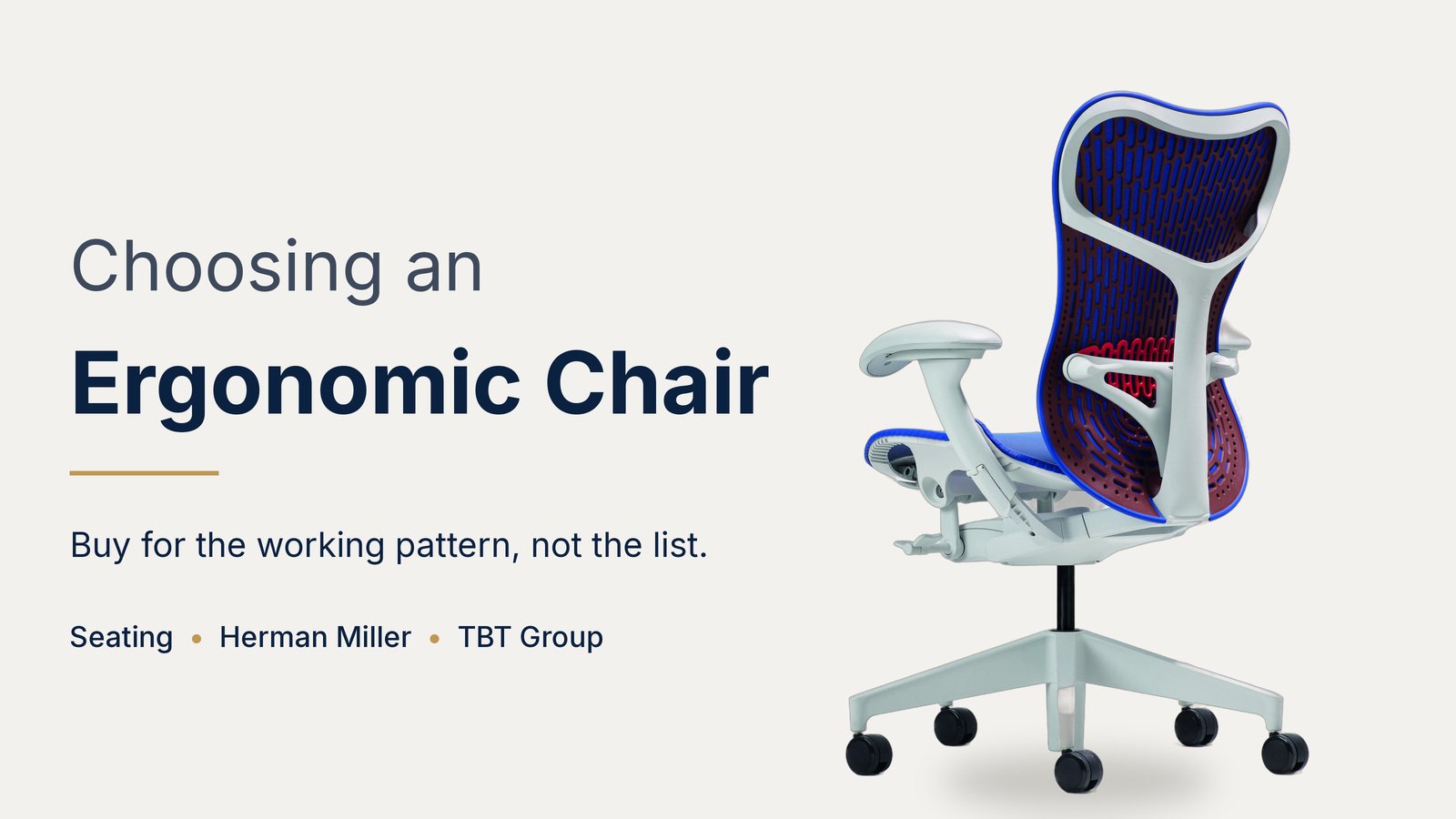
The Mirra® 2 Chair is designed around exactly this pattern — Herman Miller describes it as an agile chair “for people who toggle between individual activities and collaborative work”. Its Harmonic™ 2 tilt uses a leaf-spring design, which Herman Miller states stays balanced for sitters from 41 to 159 kilograms; its Loop Spine allows torsional flex for stretching and reaching sideways; and its Passive PostureFit® sacral support works without the user setting anything.
One specification detail worth knowing if you are buying for healthcare or laboratories. Mirra 2 offers two backs, the fabric-and-polymer Butterfly Back™ and the polymer-only TriFlex™. Herman Miller notes that because the TriFlex back has no fabric, it meets more rigorous cleaning protocols. Note that this applies to the back only — the seat material is the same on both — and that Herman Miller does not state compliance with any specific infection-control standard. If a clinical requirement is driving the decision, put the actual standard to the specifier rather than inferring it.
Pattern three: shared desks and hot-desking
Who this is. Hot desks, touchdown benches, project rooms, any seat used by a different person each day.
What it demands. This is the pattern most often specified badly, because the instinct is to buy a highly adjustable chair so it can suit everybody. In practice nobody adjusts a shared chair. They inherit whatever the last person left and put up with it.
What to look for. A chair that is right without being set. Self-adjusting tilt rather than manual tension. Consistent experience regardless of who sat in it before.
This is what the Cosm™ Chair was built for. Its Auto-Harmonic™ Tilt responds to the sitter’s vertical force — the mechanism moves the fulcrum along a leaf spring accordingly — so there is no tension dial to get wrong. Herman Miller’s own framing is that you sit down “no matter who sat in the chair before you”. For a shared desk that is the entire specification in one sentence.
The Setu® Chair solves the same problem more simply and at lower cost. Its Kinematic Spine bends and flexes without requiring any adjustment, and Herman Miller notes it provides “the same experience from chair to chair” — which is what you want across a bank of twelve identical touchdown seats.
One caveat before specifying Setu at scale: it carries a lower maximum user weight than Cosm or Mirra 2, has a fixed seat depth and a single height adjustment. For a general-population shared bank, check that range against your actual users rather than assuming it covers everyone.
Pattern four: meeting rooms, training and short-stay seating
Who this is. Boardrooms, training rooms, breakout areas, visitor seating. Twenty minutes to two hours, occasional use, high visibility.
What it demands. Comfort for the actual duration, which is shorter than people specify for. Chairs bought for boardrooms are frequently over-specified — full task chairs with lumbar adjustment and seat depth control, bought for a room used four hours a week.
What to look for. Immediate comfort, a form that suits the room, durability against occasional heavy use, and a price that reflects hours of use rather than list appeal.
Family variants help here. Cosm comes in three back heights plus a stool; Setu comes in multipurpose, side-chair and stool versions. Either lets you run one design language across desks, meeting rooms and high benches without buying task chairs for seats nobody occupies for more than an hour.
How to actually test the shortlist
Specification narrows it to two or three. Sitting decides it. Three rules:
Sit for twenty minutes, not two. Almost every chair is comfortable for two minutes. Discomfort shows up between ten and twenty, and it is the only test that matters. A showroom visit where you sit in four chairs for ninety seconds each tells you nothing except which one you like the look of.
Test with the actual desk height and the actual screen. A chair that is right at a 750 mm desk can be wrong at 720. If the office has sit-stand desks, test at standing-adjacent height too — the chair has to work at both.
Test with the people who will use it, not the people signing off. The most common procurement failure in seating is a chair chosen by someone who will not sit in it. Get two or three of the intended users into it, including the tallest and shortest people on the team.
Bring a laptop. Work for the twenty minutes rather than sitting there evaluating. You will learn more.
A short note on cost
Chairs are usually bought on unit price and lived with for a decade. Herman Miller publishes a 12-year, 3-shift warranty on Aeron, with limited exceptions — confirm the terms and the service coverage that apply in your market before treating that as part of the business case.
Spread across ten years, the gap between a mid-range chair and a premium one is a modest annual figure. Set against the cost of replacing a chair nobody wants to sit in, or of buying twice because the first specification did not fit the people using it, it is smaller still.
That is not an argument for buying the most expensive chair in every seat. It is an argument for spending where people actually sit — the six-hour desks — and specifying sensibly everywhere else. A floor of Embody chairs for a team that is out of the office half the week is as much a mistake as putting a stacking chair at a developer’s desk.
The short version
| Working pattern | What matters most | Worth looking at |
|---|---|---|
| Long focused sitting | Pressure distribution, spinal fit, support for micro-movement | Embody |
| Mobile and mixed | Immediate comfort, responsive tilt, lateral flex | Mirra 2 |
| Shared and hot desks | No setup needed, self-adjusting, consistent | Cosm, Setu |
| Meetings and short stay | Comfort for the real duration, right price for the hours | Setu, Cosm stools |
| Any pattern, mixed body sizes | Genuine size options, not just adjustment range | Aeron |
Buy for the pattern, fit the person, and sit in it for twenty minutes before you sign anything.
Planning a workspace project?
Tirupathi Balaji Traders – TBT Group supplies ergonomic seating, workstations, flooring, ceiling systems, acoustic solutions, access hardware and adhesives for commercial interiors. As a Herman Miller authorised dealer, we invite you to visit our experience centre and sit in the chairs above rather than choose them from a specification sheet.
Herman Miller, Aeron, Embody, Mirra, Setu, Cosm, Pixelated Support, Backfit, Harmonic, PostureFit, Butterfly Back, TriFlex and Auto-Harmonic are among the registered trademarks of MillerKnoll and its subsidiaries. Product specifications are as published by Herman Miller and are subject to change; confirm current specifications and warranty terms for your market before specifying.